Fressingfield Oily Rag Club -
A Unique Organisation
Fressingfield Oily Rag Club -
A Unique Organisation
“He’s dead you know – they’ve just announced it” a journalist told me as I queued for the aircraft home, Looking up at the engines I was grateful to see the reassuring Rolls Royce insignia on the jets. It had been such a terrible weekend, anything was possible.
But the story started a year or more earlier, in Amsterdam. I had enjoyed three years as Sales Director of Ford Netherlands B.V. the Dutch subsidiary of Ford Motor Company and one afternoon from my office window, I was watching a cox-less four making their way up the Binnenamstel canal. The young ladies were rowing well and had my full attention when the phone rang. “Now what have you done” my secretary asked and by way of explanation said “God’s on the phone.” I soon discovered that out of the many gods Ford Motor Company had, this particular god was Vice President of Ford of Europe Marketing. “Steve, the US have given us back the F1 programme and we’d like you to run it so pack up in Amsterdam and get back to good old Warley.” Warley was then Ford of Europe’s HQ at Brentwood in Essex.
The job I found out was managing relationships between our works team Benetton, our engine manufacturers Cosworth and a number of other teams using the Ford HB engine. The relationships were to be governed by two legally binding agreements. One between Ford and Benetton which set out what we would supply them with in terms of engines, rebuilds, engineering resources and money and what they would do in return in terms of signage, access to drivers and key personnel, publicity and other marketing/PR activities. The other agreement, between Ford and Cosworth, designated the engine development programme, the monies involved, Ford engineering support and the supply of engines to third party teams. It was September 1992, Schumacher had just scored his inaugural F1 win in Belgium and we were tying up arrangements for the 1993 season and so, “lawyered up” I took my first steps into the unknown.
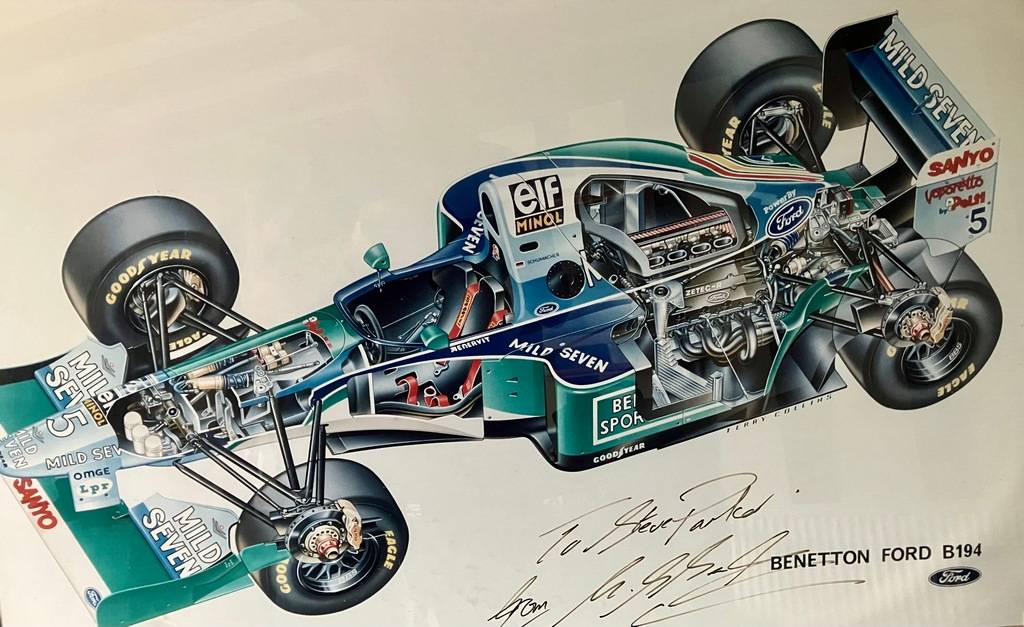
The Benetton B194 autographed for the author by Michael Schumacher
as a farewell gift
The first race I attended was in Portugal and the first team owner I met was Sir Frank Williams. “Welcome to the piranha club” he quipped. I was soon to find out what he meant. Meanwhile Ford in the USA felt you could get a bigger bang for your buck in other areas of sponsorship than in F1. This was a bit rich given their prior stewardship of the programme but then, American business folk don’t do irony. So for the first couple of weeks of my new job, I was having to justify continued participation and my continued employment! This was followed by budget reductions which seriously impacted getting agreements signed with Benetton and Cosworth. McLaren found themselves without an engine supplier and as one of most prestigious teams with a driver pairing of Senna and Andretti, had expectations that were near impossible to meet. Factions within Cosworth, which was part of Vickers at the time, were concerned about the development of a new V8 engine for 1994 in place of a V12 that some wanted. I had no experience within motorsport other than driving in a handful of rallies in the seventies; my negotiating skills, if they could be called that, consisted of the monthly allocation wrangle of new vehicles to Ford dealers. I had only one thing on my side and that was time pressure. The teams had to have their engine supply and sponsorship arrangements tied down in sufficient time to be able to develop their cars and programmes. Mindful of the confidentiality agreements that were in place and not knowing whether any statute of limitations still exists, let’s just say that with a load of horse trading and to-ing and fro-ing between Enstone, Northampton and Woking we muddled through. The agreements got signed and the 1993 season started.
Looking back 1993 was quite a good year for Ford. Although the Williams Renault cars dominated, Ford engined cars won 6 Grands Prix; 5 by Senna and 1 by Schumacher and a load of podium finishes. This wasn’t the way Benetton wanted it, believing the works team should be allowed to dominate but that was ignoring Senna’s contribution. His mastery on tight or wet surfaces came to the fore although every time he won the press attributed the victory to his skill and every time he lost, they talked up the alleged power advantages of the V10 and V12 cars. Press interviews which at the start of the season had been straightforward, became tricky and I had to learn the hard way how to handle the press.
By Imola, another issue that had been festering for some time came to its head, that of engine equality between Benetton and McLaren. The agreements laid down specific conditions on engine equality which meant in layman’s terms that Benetton would get upgraded engines a defined time before other teams could have them. All parties agreed to this without the knowledge that the air valve modification to the HB would allow it to rev significantly higher than the spring valve unit and unlock a hitherto unseen tranche of power. As part of these discussions I suffered a stormy meeting with Ayrton Senna in the McLaren motorhome. Ayrton simply couldn’t believe we were sticking to a contract. “Do you want to win a world championship” he asked with a look of anger tinged with despair “I am the world’s best driver - give me your best engine.” His expression turned to one of disgust when I explained we weren’t prepared to break our agreement even though secretly I would have loved to!
Our Chairman decided to pay a visit to Imola so I went to greet him and bring him into the paddock. The air valve issue had leaked, it’s very hard to keep things secret in F1, and a crowd of about 100 journalists and camera men quickly gathered to quiz me on whether McLaren would get the latest engine. I had been hiding in our motorhome on Friday and Saturday to avoid them and they were out for blood. Our Chairman mistakenly thought they were there to interview him and looked bemused when they swept past him and surrounded me. I remember thinking “this b****y job is career damaging!”
I went to the 1993 Brazilian Grand Prix with some trepidation. Ford Brazil had received death threats against me for not providing Senna with the air valve engine earlier in the season. So I was given a bodyguard - a taciturn fellow, not a jot like either Brodie or Doyle, but he had a large bulge under his armpit. Fortunately, his services were not required. McLaren invited me to a pre-race dinner and I dutifully ordered a taxi to get to their hotel. The taxi driver said “McLaren are staying at this hotel and so too is Ayrton.” I told him that I was going to dinner with the McLaren team and that, no doubt, Senna would be there too. The taxi driver begged me to get Senna’s autograph and I said I would do my best. At dinner, I asked Senna to sign the menu which he did happily and, getting back to the cab, I gave it to the driver. He offered me money, his wife, his sister for the autograph but I insisted that I didn’t want any reward. Not taking no for an answer, he gave me his services, gratis, for the entire weekend, taking me to and from the circuit. I will never forget arriving at the circuit on race Sunday the same time as Senna. As he passed through a corridor made of wire netting, local Brazilians pushed their fingers through the mesh just to be able to touch their hero. It was as though Jesus himself was passing through them. The weather turned during the race from sunshine to a torrential downpour, Prost hit the kitty litter, Senna shot to the front and won his home Grand Prix. Brilliant!
A few weeks later in Australia, Senna won again. It was to be his final victory. The race in those days was held in Adelaide on a street circuit. In order to minimise potential traffic jams at the conclusion of the race, the organisers decided to stage a pop concert hoping this would encourage a lot of spectators to delay their departure. The main act was Tina Turner. I’m not sure how much she knew about F1 but she called Senna on stage. The world’s best driver, one of the most self-assured people you could imagine resembled a frightened schoolboy in front of a draconian teacher. Poor Ayrton was visibly rattled by the amazing Ms Turner strutting her stuff. When she belted out “Simply the Best” to his face he literally blushed Ferrari red!
Ultimately Senna moved to Williams, McLaren switched to Peugeot for their engines and Benetton got the brand spanking new Zetec R engine, the fastest revving V8 of its time. I had been learning how to negotiate under the tutelage of some of the toughest negotiators in the world! So this time and without McLaren to worry about, and an HB engine available for “customer” teams, agreements for the 1994 season were a lot easier.
The new Zetec R engine was superb. Schumacher won the first Grand Prix of the 1994 season in Brazil and also took first place in the Pacific GP in Japan, at San Marino, and Monaco. I didn’t go to these races because my employers had decided that as well as F1 duties, I should also take care of European advertising. After all, they only race for eight months a year and then at weekends every two weeks or so! I decided to go to the next race, the San Marino GP at Imola but in retrospect, wished I hadn’t.
My memories are of a long and continuous series of disasters. When we arrived we were told of an accident in a supporting Porsche race for amateur drivers. Apparently one of the cars had crashed and the driver was paralysed. In the Friday practice session, Barichello crashed heavily but fortunately was not badly injured. Worse was to follow. Roland Ratzenberger driving a Ford engined Simtek crashed during the second qualifying session on Saturday and did not survive the impact. He was the first F1 driver to have died since the eighties. On race day, there was a huge pile up at the start with bits of race cars thrown into the stands and several spectators were injured. The safety car was deployed and Senna made a perfect restart into the lead. As you all know it wasn’t to last. After just a few laps Senna crashed heavily at Tamburello. Senna was taken away by helicopter to the hospital, nobody knew how badly injured he was and somehow the race continued. The drama continued as well however. A Minardi lost a wheel after a tyre change which bounded through the pits injuring a number of mechanics. Schumacher won but nobody, including Michael, cared. I was desperate to get home - to normality and routine. Outside the circuit, a coach crushed a Fiat 500 and I can’t imagine the occupants stood much chance. I made the airport and made it home - relieved.
I didn’t stay a lot longer in F1 but was delighted to see Michael Schumacher win his first World Championship driving a Ford powered car. The gods decided I should spend time in other areas of the corporation and frankly, I was not altogether sorry to get back into my comfort zone. I had learned a great deal from F1 chiefly about the personal qualities that drive success, especially when individuals or teams internalise a desire to win. But it’s a sport that demands and takes a great deal from all involved.
Copyright © 2011-2026 Fressingfield Oily Rag Club. All Rights Reserved.
GDPR Policy Club Rules Refund policy Stradbroke Map FAQ's Follow us Opens a new window
 Opens a new window
 Opens a new window
 Opens a new window